
Gameplay System Designer
 Unreal Engine
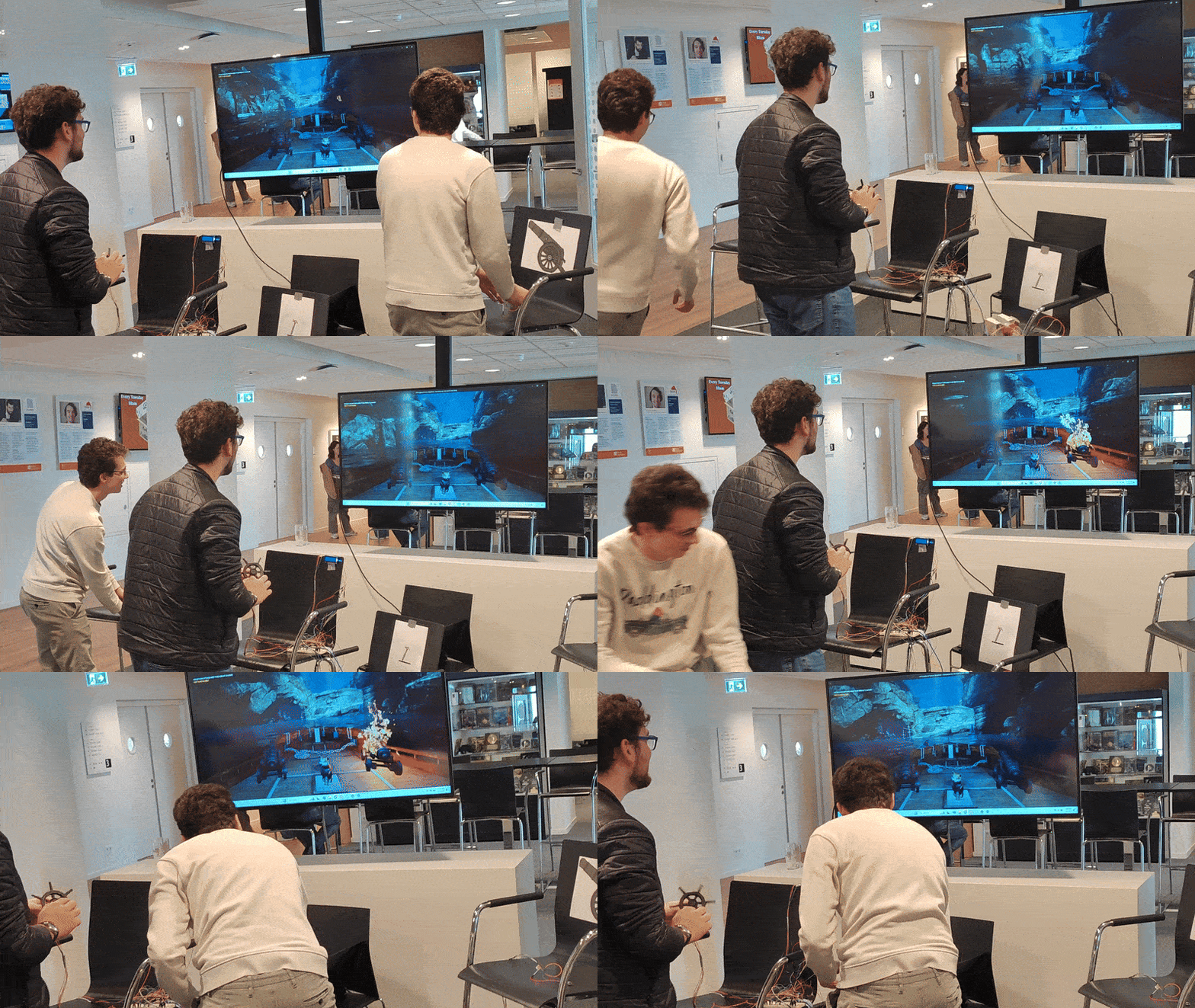
 Rivertale is an XR co-op adventure game played on an 8m x 3.5m screen with custom Arduino-powered props: a capstan, steering wheel, and cannons. You and your crew navigate a ship through hell, fighting enemies and managing constant forward momentum.
The game blends the physical chaos of Overcooked with the full-body engagement of Wii Sports: communication is not optional, it is the mechanic.
Personal Contributions
My Contribution
As Gameplay System Designer I owned all enemy types from design through shipping, built the anchor and guidance systems, handled 3Cs design, and drove comfort and safety iteration across the full XR experience.
Design Pillars
Forced Momentum
The ship never stops. Constant forward motion creates urgency and forces players to react rather than plan idly.
Chaotic Coordination
Survival depends on communication. Role division and physical controls demand constant teamwork under pressure.
Core Gameplay Loop
A tense co-op loop built on three constraints: the ship is always moving, roles are divided between pilot and crew, and every action requires a physical prop.
Structure
The pilot steers via a rotary encoder while the crew manages cannons, the anchor, and repairs. No single player can handle everything. The ship's constant forward motion means indecision has immediate consequences: every second spent not communicating is a second closer to a wall or an enemy swarm.
Short, legible encounters follow an "I see this, it does that, I respond" pattern. Each challenge is designed to be read and solved within the time the ship takes to pass through the area.
Why It Works
The inability to stop the ship transforms communication from optional to structural. Players verbalize needs, delegate tasks, and solve problems in real time under real pressure. The Arduino props make every action tactile: twisting the steering wheel, spinning the capstan, loading the cannon.
Enemy Design
Three enemy types, each with a distinct role in the encounter structure: damage dealer, setup tool, and final test.
Ranged Enemy (Damage)
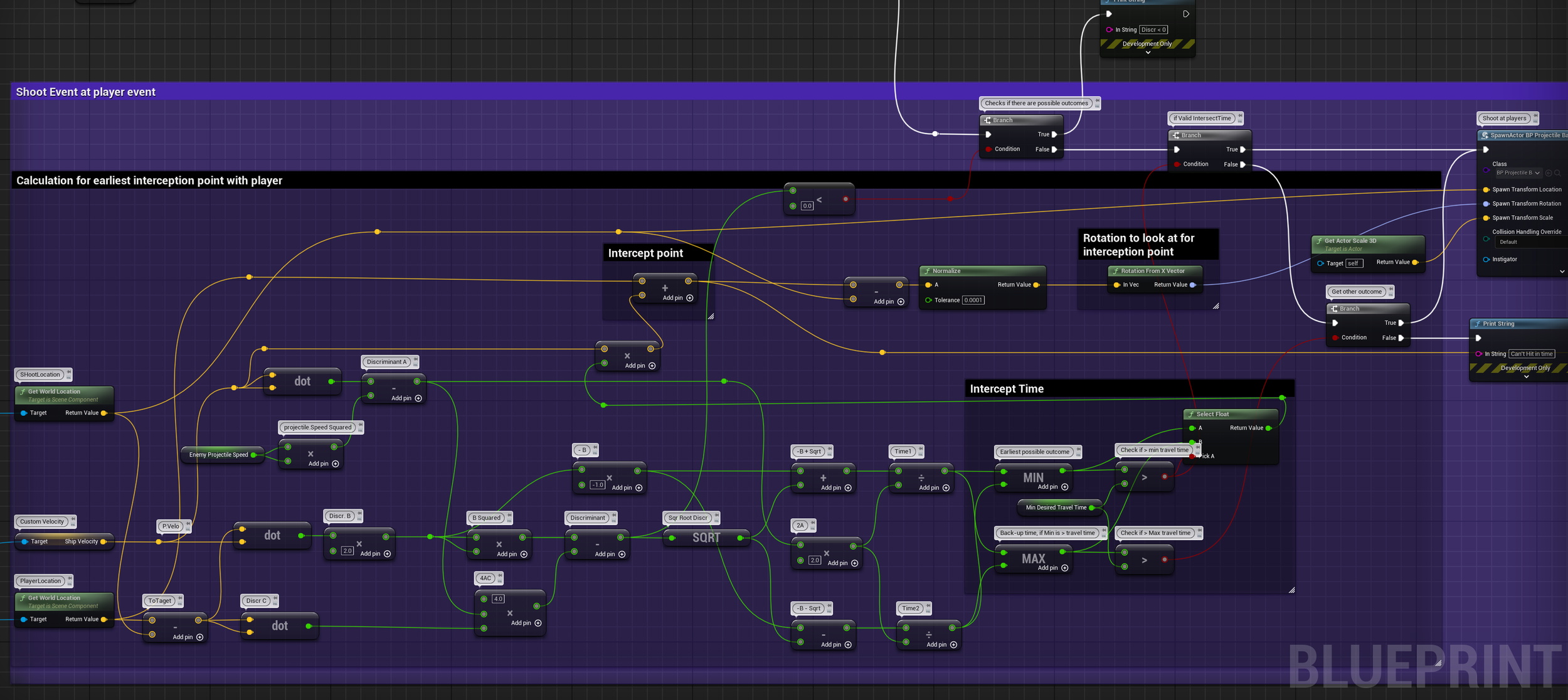
Fires slow projectiles that use a quadratic intercept formula to predict where the player will be if they do not move. Shots are dodgeable but threatening, forcing players to decide: dodge, shoot, or handle another active task.

Intercept formula sketch
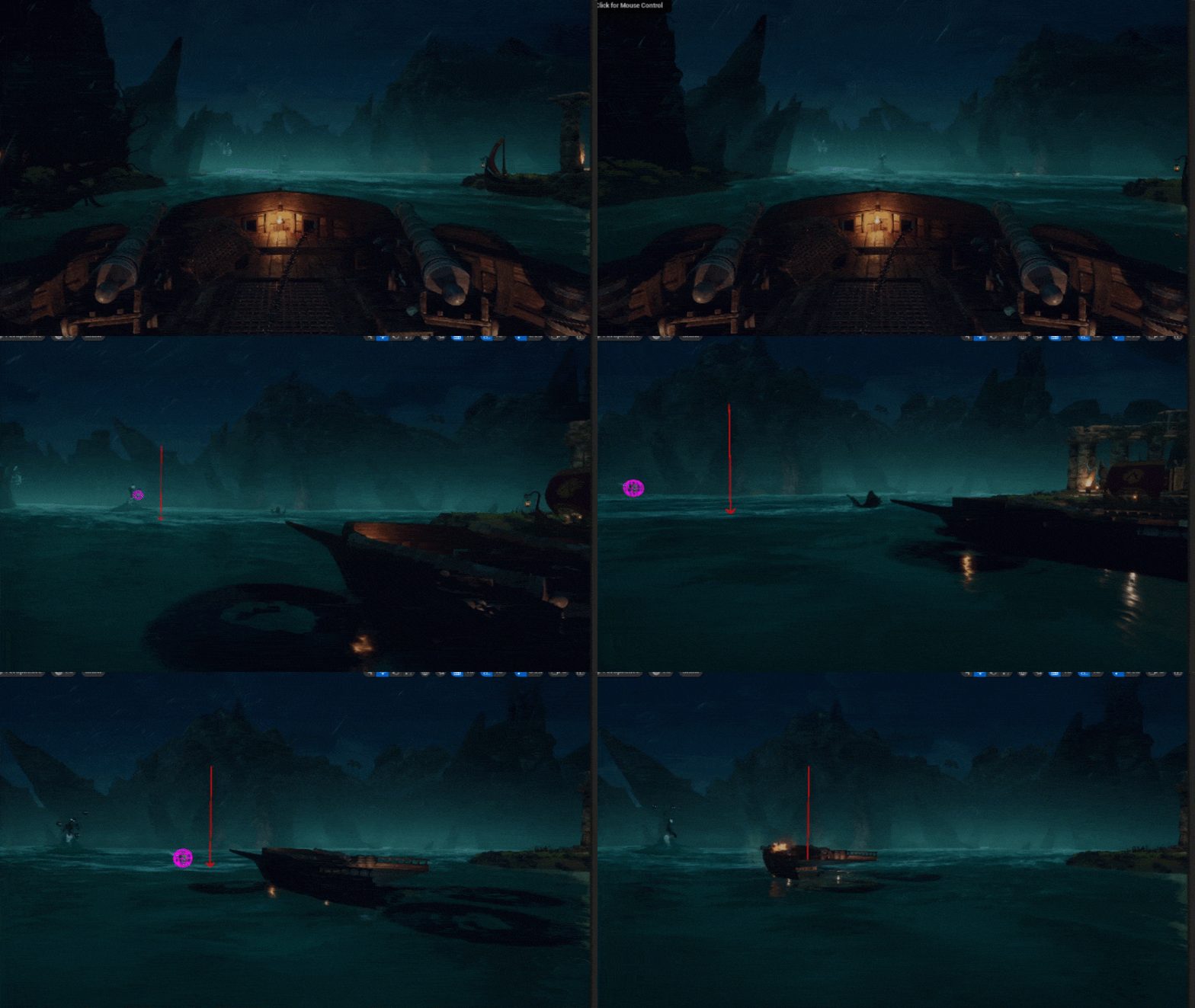
Result in action
The system uses player velocity and position combined with projectile speed to calculate the future intercept point, converting it to a rotator for projectile spawn. An animation notify triggers the exact spawn frame. The result: readable threat, not random punishment.
Swimming Enemy (Setup)
Spline-based movement triggered by a trigger box. Speed stays constant via a rate calculation over the full spline path. Level designers place the enemy and adjust the spline: no code required.
During playtesting, players kept trying to shoot this enemy even though it was intended as a setup tool, not a combat target. Rather than blocking the behavior, I made the enemy killable. Players had more fun, communication increased, and the encounter became richer. Sometimes the player solution is better than the design solution.
Boss Enemy (Final Test)
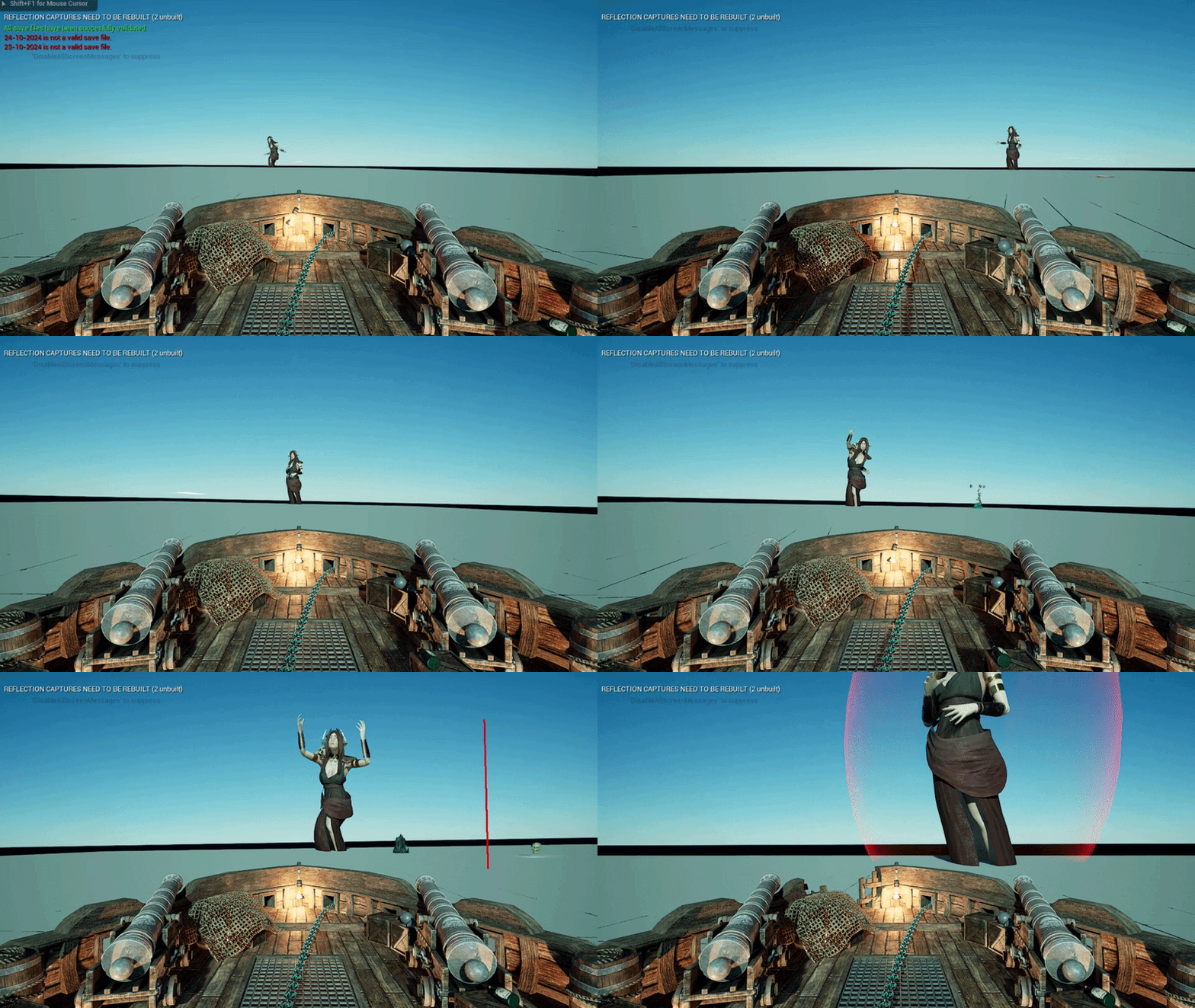
The boss is the climax: a spline-based rock projectile drops the anchor, stops the ship, and forces the crew to react while still under attack. At close range she switches, swapping between summoning a damage-dealing statue or spawning a ranged enemy, keeping pressure unpredictable.
Iterations & Challenges
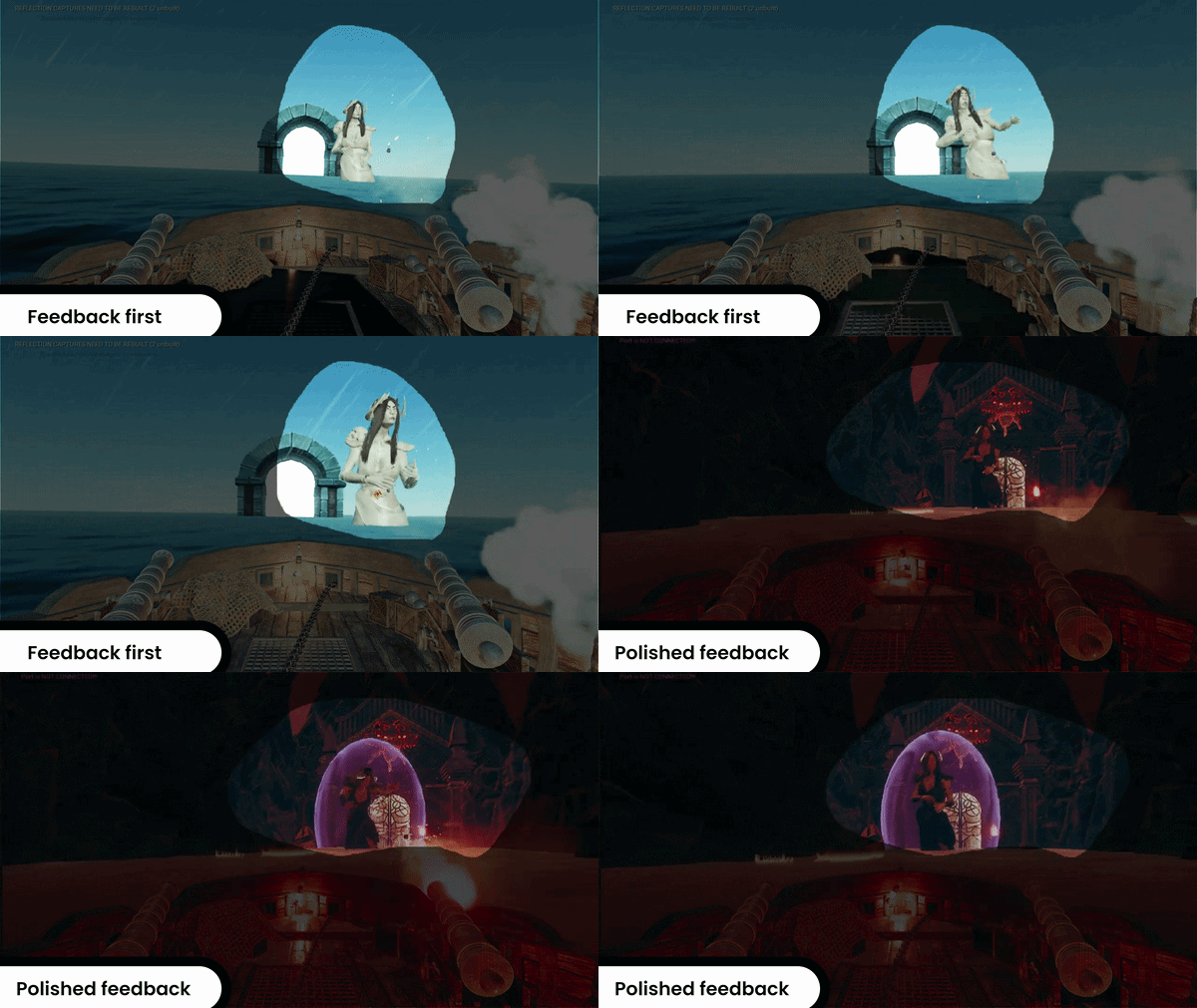
Before & after: old iteration vs. improved feedback model
Better feedback made the boss more fun and strategic. When players could visually read what was happening, they stopped guessing and started planning, turning a confusing encounter into an intentional one.
Anchor System
An enemy-triggered mechanic that stops the ship completely, forcing a player to sprint to a physical capstan prop and spin it to restore movement.
How It Works
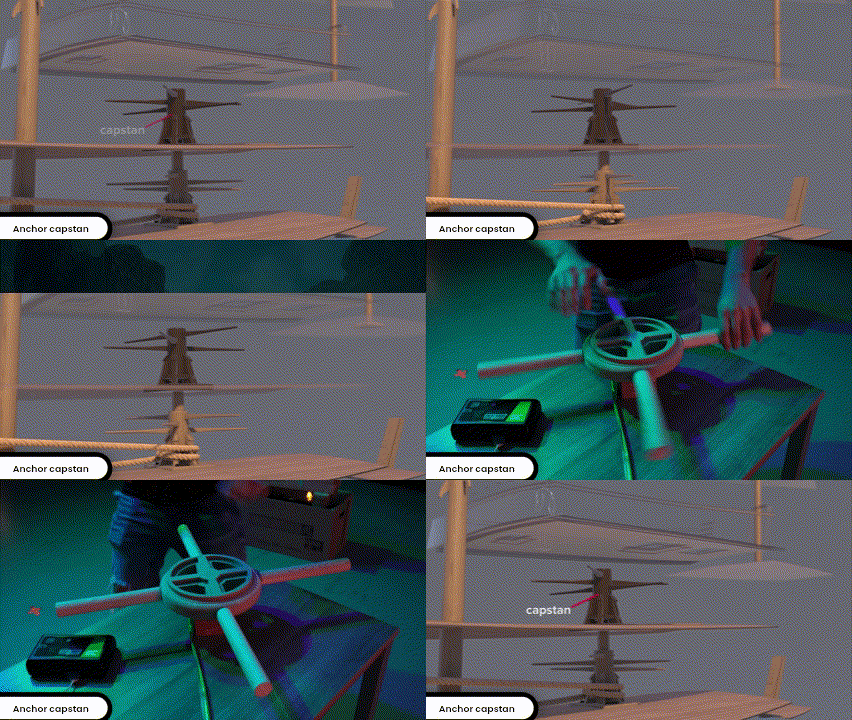
An enemy drops the anchor, instantly overriding the ship's speed to zero. A player must reach the physical capstan prop (containing a rotary encoder) and rotate it in the correct direction. The Arduino reads encoder input and increments a float until it reaches maximum, at which point the anchor raises and movement resumes.
The first prototype used a button hold, which felt arbitrary. The final rotary encoder solution creates physical feedback that matches the mental model: you are winding up rope. A motor in the prop physically lowers a visual element when the anchor drops in-game.
Design Evolution
Players dropped the anchor themselves. A mis-timed press stopped the ship with no enemy responsible, creating blame confusion and accidental self-sabotage. Removed clarity from the tension loop entirely.
Enemy control gives clear cause-effect. Spinning a capstan to raise a ship anchor is physically intuitive. The motor dropping a prop element when the anchor drops in-game makes the state change tangible, not just visual.
Ship Guidance System
A non-intrusive correction system that prevents players from turning around or leaving bounds, while preserving a genuine sense of freedom.
How It Works
Invisible guidance splines follow the river's center path. The ship smoothly interpolates back to the path if it deviates for more than 4 seconds. A 110-degree detection arc (55 degrees left and right of the ship's nose) checks for spline presence: within the arc, no correction; outside it, auto-return triggers.
V2 added collision-triggered border splines for hard-boundary edge cases. On contact, the ship instantly but smoothly reorients. The 4-second delay gives players enough room to feel free while preventing real exploits.
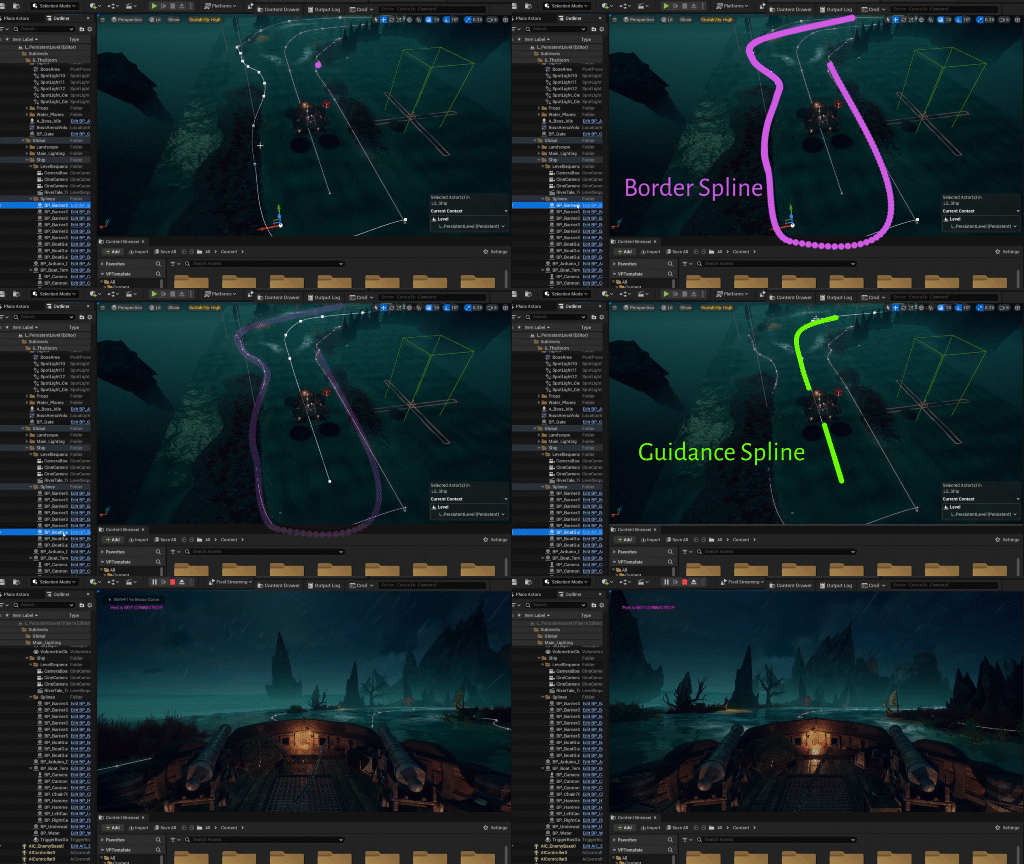
Why It Matters
QA revealed that players fought the forward momentum, causing frustration and out-of-bounds states. The solution was not restricting them more. It was giving them the illusion of freedom within safe bounds. Players stopped noticing the system and started focusing on objectives.
XR Stage
An 8m x 3.5m screen with lighthouse tracking and custom Arduino props: every in-game action maps to a physical interaction in the real space.
The stage's scale, the big screen, and the lighthouse tracking system were the constraints we built around. Custom Arduino kits became cannons, an anchor capstan, and a steering wheel. Performing any action in the physical space translates directly to the screen, creating a level of immersion impossible with standard controllers.
Safety & Comfort Design
Iterative solutions to reduce collision risk, motion sickness, and prop-interaction confusion in a large-scale physical play space.

Floor plan sketch
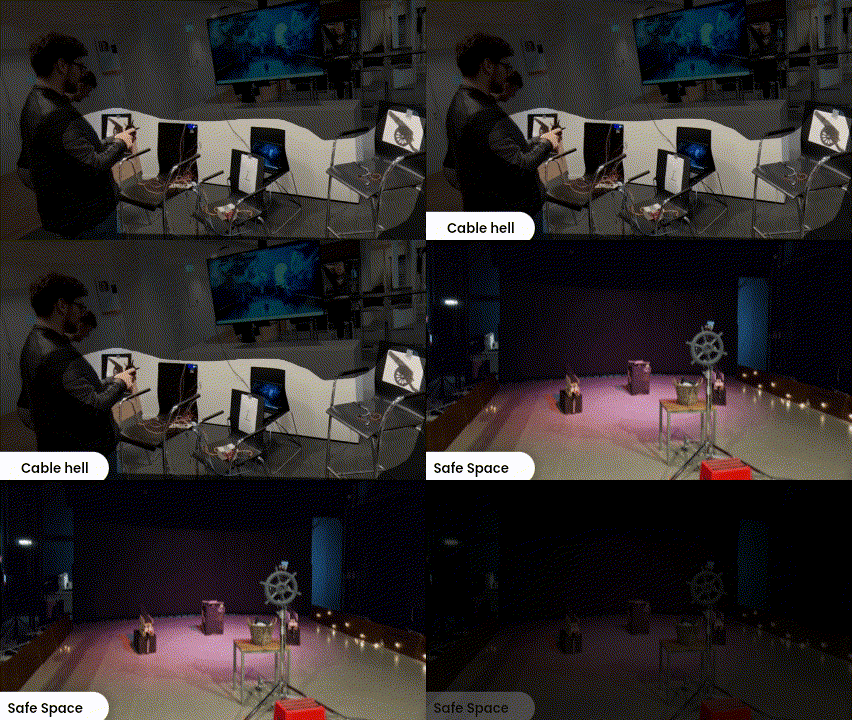
Cable hell — before wireless
Key Iterations
Wired to wireless: early builds used wired Arduino connections in a cramped space, creating tripping risks. Switching to WiFi receivers let us spread props across the full play area.
Stationary pilot: a moving pilot at elevation risked falls. Anchoring the pilot position and designing steering challenges around that constraint eliminated the risk while creating new tactical interest.
Prop feedback: players interacted too roughly with props because they assumed they were broken. Changing the trigger condition (first interaction requires multiple presses to "repair") and adding clear VFX and SFX cues fixed the expectation mismatch.
Why This Matters
Discomfort is not immersion. Players cannot engage with an experience if they feel physically at risk. Safety design is not a constraint on the creative work: it is the precondition for it.