Game System Designer
 Unreal Engine
 Mow Down is a local party game where players drive lawnmowers, collect resources by mowing grass, and use them as ammunition against each other. Think tank brawler meets chaotic party game: the tactical feel of Wii Play: Tanks with the energy of Boomerang Fu.
The game is built around a single physical constraint: lawnmowers do not turn instantly. That one design decision shapes every system on the page.
Personal Showcase

My Contribution
As Game System Designer I designed and built the core game loop, 3Cs, boost system, and respawn system across 8 weeks with a team of 14. My focus was making lawnmower movement feel tactile and using that feel as the foundation for all competitive tension.
Design Pillars
Mow to Power
Collecting resources through mowing ties battlefield control directly to offensive potential.
Dynamic Comeback
Smart respawn positioning and i-frames ensure every loss creates a fair new opportunity.
Core Gameplay Loop
Mow grass to earn ammo, use ammo to hit opponents, respawn to a safe position, repeat. Every element of the loop creates a reason to keep moving.
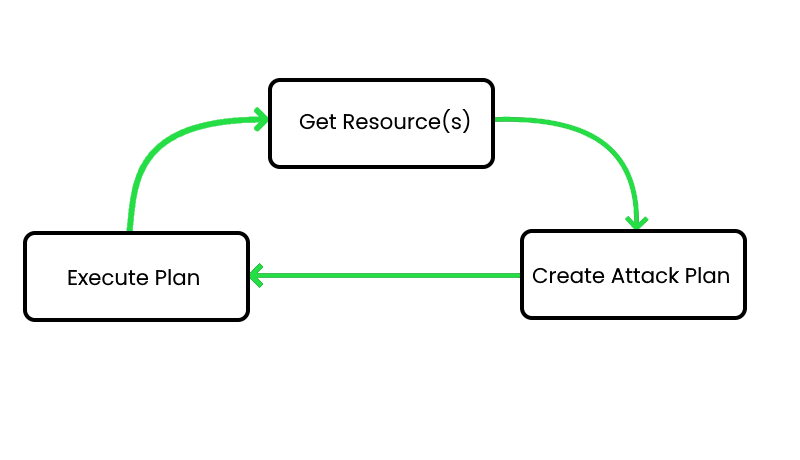
The loop is intentionally tight. Standing still means collecting nothing. Chasing means overcommitting and exposing your turning weakness. The best players control the mowed terrain, not just their opponents' movements.
Boost System
A resource-based speed burst that rewards active mowing and gives players a repositioning tool when they are losing ground.
How It Works
Mowing uncut grass fills a boost charge. Holding the boost button drains the charge and dramatically increases speed. UI elements surface the resource state without requiring players to look away from the action.
Why It Was Made
Playtests revealed a recurring problem: after taking a hit, players felt stranded while opponents hid at the edge of the arena. The game stalled. The boost system breaks this pattern. It gives the losing player a tool to close distance, creates a risk for the leading player (they may be chased), and adds a meaningful decision: when do I burn my charge?
No cost. Players boosted constantly, which stripped tension from close encounters and made boost feel like a passive speed upgrade rather than a decision point.
Boost charge fills only by mowing. This ties speed bursts to terrain control, creates a trade-off between repositioning and resource gathering, and rewards the losing player for staying in the game.
Respawn System
A coverage and distance scoring system that selects the safest available respawn point, preventing spawn camping and immediately breaking face-off stalemates.
How It Works

On hit, the player launches into the air. The system scans a predefined array of respawn locations, scoring each one by distance from the opponent and coverage from direct line-of-sight. The highest-scoring location wins. The respawning player receives invulnerability frames on landing to guarantee a safe window.
Why It Was Made
Without a respawn system, players consistently ended up in direct face-offs: two players staring at each other, waiting for the other to move first. Whoever had more ammo or faster reflexes won, but neither player had made a meaningful decision.
The respawn system breaks the deadlock by physically separating players on every hit. The i-frames prevent spawn camping. Together, they keep the game moving and ensure the outcome depends on skill over position luck.
Character Movement
Smooth rotation interpolation that gives the lawnmower realistic turning inertia, transforming a physics constraint into a skill gap.
How It Works
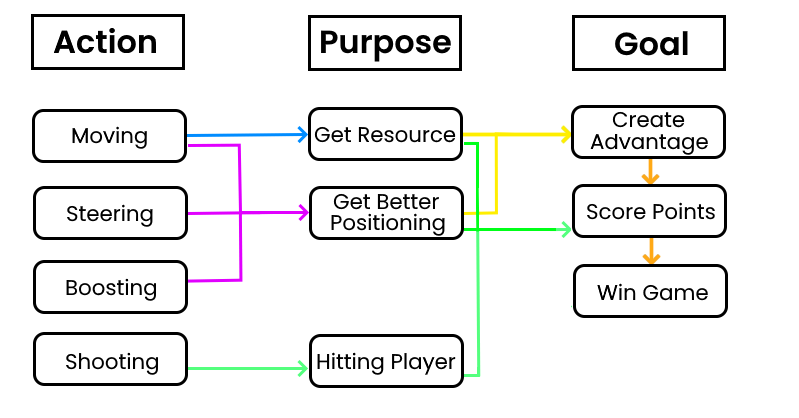
Rather than instant rotation, the character interpolates between the current orientation and the desired one over a short interval. The feel mimics a real lawnmower: you can commit to a direction change, but momentum carries you slightly past your intention.
Why It Creates Tension
The turning delay introduces a punish window. Players who overcommit to a direction can be caught mid-turn. Players who learn to anticipate the delay can set up shots by forcing opponents into unfavorable turning angles. A movement system that reads as "slightly awkward" on first play becomes "deeply strategic" on the third.